A dollar. A buck. A greenback. A single. A one. A George Washington. No matter what you call it, the U.S. $1 bill has a fascinating history.
Considering how often $1 bills pass through our hands, it’s surprising we don’t know more about this common note.
Look closely at the $1 bill and you’ll see an intricate design with numerous symbols, an imprint of the Great Seal of the United States and several Latin phrases. Some of the images have given rise to conspiracy theories about secret messages coded into the bill’s design.
Let’s take a look at 33 of the most interesting facts about the $1 bill (and perhaps put those conspiracy theories to rest.)
1. $1 Bills Aren’t Made of Paper
2. $1 Bills Are Durable
3. You Can Spend Torn $1 Bills
4. Almost Half of All Bills Made Are $1 Bills
5. How Many $1 Bills Are Made Annually?
6. Just How Many $1 Bills Are Out There?
7. The Cost of Printing $1 Bills Is Low
8. Why They’re Cheaper to Make
9. Every $1 Bill Has a Unique Serial Number
10. The Average Lifespan of a $1 Bill
11. Old Bills Are Still Legal Tender
12. But You’re Better Off Not Spending Old Bills
13. The First $1 Bills Didn’t Feature George Washington
Chase didn’t realize his Presidential ambitions, but he did become a Supreme Court Justice.
14. George Washington First Appeared on the $1 Bill In…
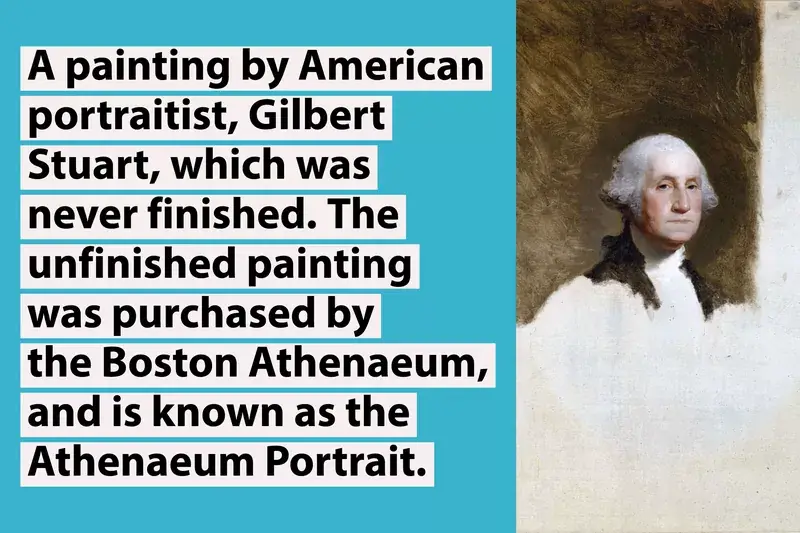
15. The Portrait of George Washington on the Front of the $1 Bill Came From…
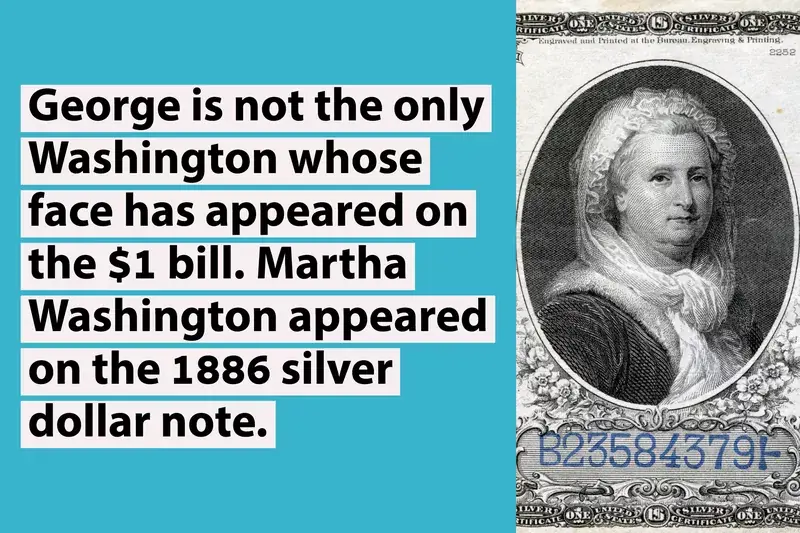
16. A Family Affair
17. The Design Hasn’t Changed in Over 50 Years
18. The U.S. Government Has no Plans to Change the $1 Bill
19. What’s That Date Again?
20. Lucky 13
21. Lucky Thirteen, Part 2
In addition, the Latin phrases printed on the note — “Annuit Coeptis” and “E Pluribus Unum” — contain 13 letters. The Department of the Treasury seal includes 13 stars.
22. Lucky 34
Even though 11 states broke away from the Union to form the Confederacy, Treasury officials kept the 34-sided seal on the note, perhaps in the hope that the Union would re-form. Which it did.
23. Conspiracy Theorists Have Other Ideas
24. About the Great Seal
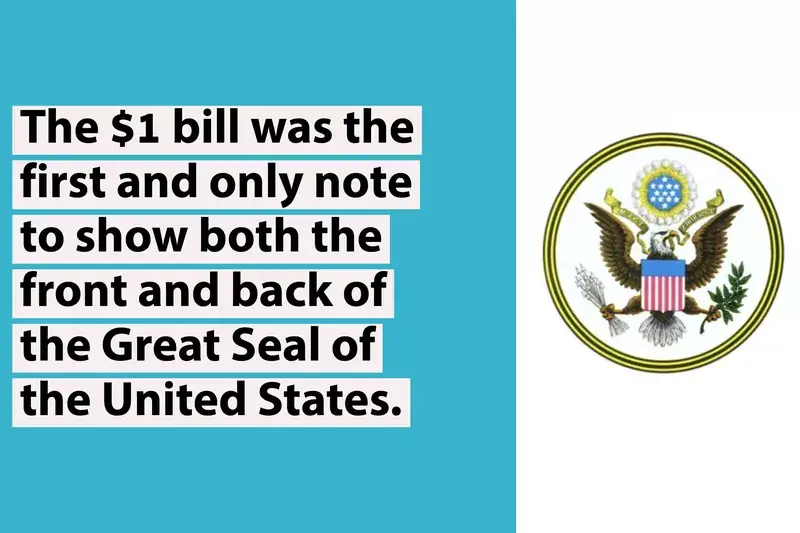
25. War and Peace
26. The Olive Branch and the Arrows in the Eagle’s Claws Used to Be Reversed
To dispel this rumor, and to appease fearful allies, a new design was chosen, showing the eagle with the olive branch in its right claw, and arrows in the left.
27. Is It a Bird?
28. Again, Conspiracy Theorists Have Other Ideas
29. It’s Latin to Me
30. The Meaning of the Phrases
31. The Vending Machine Industry Doesn’t Want the $1 Bill Changed
If the $1 bill were changed, the cost of altering or refitting vending machines to recognize the new bills would be prohibitive, according to an Atlantic article.
32. Vending Machines, Continued
President George W. Bush’s administration blocked a possible redesign in the early 2000s out of concern for the financial impact on the industry.
33. Some People Do Want the $1 Bill to Go Away
In 2012, Senators John McCain (R) and Tom Harkin (D) introduced a bipartisan bill to replace the $1 bill with a coin. It didn’t pass.
34. It’s the Only Bill That Gets Tested
However, the web press couldn’t do long runs, so the Bureau stopped using it in 1995. Any $1 bills made this way are marked Series 1988A, Series 1993 or Series 1995 and are very valuable.
35. Never Put Your Money Where Your Mouth Is
36. You Can Track Your Bills
Here’s the link to Where’s George.
37. ‘In God We Trust’ Is Law
38. ‘In God We Trust’ First Appeared on Paper Money in 1957
39. The Seal of the Department of the Treasury Appears on Every $1 Note
40. Before 1996, U.S. Bills Featured the Seal of the Individual Federal Reserve Bank Where They Were Made
41. The First $1 Bills Issued With George Washington’s Face Didn’t Show the Great Seal
42. Benjamin Franklin and Thomas Jefferson Wanted an Egyptian Pharaoh on the Great Seal
43. They Also Wanted to Put the Motto ‘Rebellion To Tyrants Is Obedience To God’ on the Great Seal
44. How Long Would $10 Billion $1 Bills Last You?